


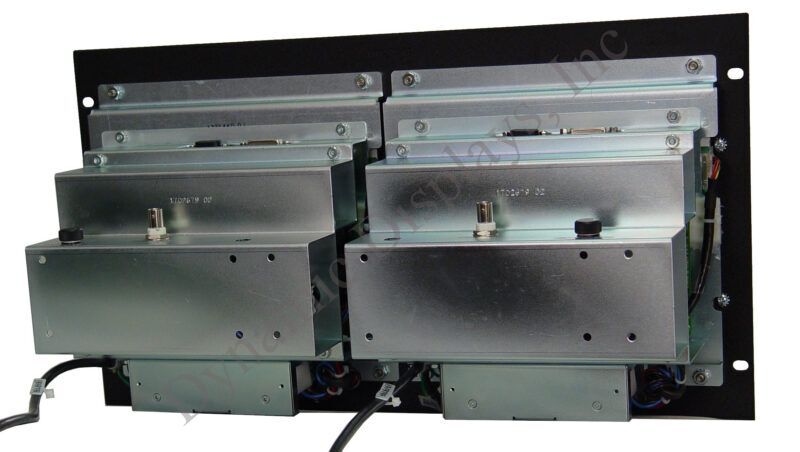
QES1508-402 Dual RackMount 8.4-in LCD Monitor w/Differential BNC Video
QES1508-402 Dual Rack Mount 8.4-inch LCD monitor accepts RS170/RS343 differential monochrome Video Input for enhanced noise-immunity, as well as VGA and HDMI video for full-color video. The QES1508 series Rugged Rack Mount LCD Monitors are designed specifically for Industrial Display applications in severe environments.
Occupying just 6 standard EIA RS310 D rack units on a 19 inch equipment rack, model QES1508-402 features two high resolution 8.4 inch LCD screens with completely independent OSD controls and video inputs. Each 8.4-inch LCD display of this Dual Rack Mount accepts RS170/RS343 differential monochrome Video Input for enhanced noise-immunity, as well as VESA standard VGA and HDMI video for full-color video.
Dynamic Displays' Rugged mew QES1508-402 Rackmount LCD Monitor is ideal for Industrial Display applications in high-noise environments. Occupying only 6 standard EIA RS310 D rack units on a 19-inch equipment rack, these versatile Dual Rack Mount displays feature two high resolution 8.4-inch LCD screens with completely independent OSD controls. Each display accepts RS170/RS343 differential monochrome Composite Video Inputs for enhanced noise-immunity, as well as VESA-standard HD15 VGA and HDMI video for full-color video. Each LCD screen of the QES1508-402 provides image reproduction that exceeds all other displays available in a similar form factor. Each panel of the QES1508-402 operates with legacy signal timings such as RS-170 (525 Line) and RS-343 (875-Line) Interlace formats, as well as VESA-standard VGA and HDMI formats. Pick your configuration. You can display monochrome RS343 video on one screen and full-color digital HDMI video on the other. Dynamic Displays' sturdy rackmount LCD monitors are used in many military, industrial, manufacturing, transportation applications, and other uses that require bright, crisp images and versatile signal interfaces in severe environments.

Differential Video Capability input and output signals
Advantages of Differential Signals
Following are the key benefits of differential signaling.- High Resistance to electromagnetic interference (EMI) because the signals are transmitted on balanced lines.
- Low EMI Radiation.
- Reduced Crosstalk: Minimizes electronic crosstalk between signals.
- Better common-mode rejection and improved power supply rejection.
- Harmonic Cancellation: Offers inherent cancellation of even order harmonics. Pre-distortion techniques can further reduce odd harmonics.